

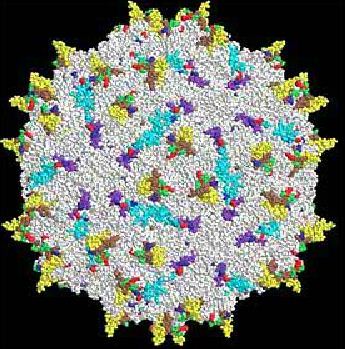
Dr. Srivastava’s laboratory has made seminal contributions to the field of parvoviruses, which include:
- identification of cellular co-receptors for AAV as well as parvovirus B19
- elucidation of various steps involved in parvovirus trafficking in the cell and nuclear transport
- identification of cellular proteins involved in the regulation of AAV DNA replication and encapsidation
- development of recombinant AAV and parvovirus B19 vectors
- transgenic and knockout mouse models to study parvovirus-induced pathogenicity, and the use of parvovirus vectors for gene transfer and gene therapy
Parvovirus-based vectors have gained attention as a useful alternative for human gene therapy. The stable integration of the AAV genome, and the erythroid cell tropism of B19 have been exploited to construct the following two types of AAV-B19 hybrid vectors.
Type I vectors allow stable integration of the viral DNA in infected cells but the viral gene expression occurs predominantly in the erythroid progenitor cells.
Type II vectors allow efficient erythroid progenitor cell-specific gene therapy as well as expression of transduced genes.
Recently, Dr. Srivastava’s laboratory has developed the next generation (“NextGen”) AAV vectors in which the viral capsid has been modified to achieve high-efficiency transduction at significantly reduced vector doses. More recently, his laboratory has also modified the AAV genome to develop the generation X (“GenX”) AAV vectors with which increased transgene expression can be achieved.
The NextGen AAV vectors have been used by other investigators in a Phase I Clinical Trial for Leber’s Hereditary Optic Neuropathy (LHON). The NextGen and the GenX vectors have been combined in Dr. Srivastava’s laboratory to develop the optimized [“Opt”] AAV serotype vectors, and the current emphasis is on the potential gene therapy of genetic diseases such as β-thalassemia and sickle cell disease, and malignant disorders such as hepatoblastoma and hepatocellular carcinoma.
Potential Gene Therapy of Sickle Cell Disease and β-Thalassemia
Human hemoglobinopathies, such as sickle cell disease (SCD) and b-thalassemia, are by far the most common (1 in 600) monogenic diseases worldwide, and are among the likely candidates for their potential treatment provided that pluripotent hematopoietic stem cells (HSCs) can be stably transduced, and long-term, regulated expression of a functional b-globin gene in the erythroid progenitor cells can be achieved.
Potential Gene Therapy of Human Liver Cancer
Two of the most common liver cancers include hepatoblastoma (HB) in children, and hepatocellular carcinoma (HCC) in adults. HB is the most frequent pediatric liver cancer in the United States. HCC is one of the five most common cancers involving solid tumors, and is highly fatal. HCC is rapidly emerging as a clinically important disease in developed countries and of grave concern is its increasing incidence to epidemic proportions in certain areas of the world.